
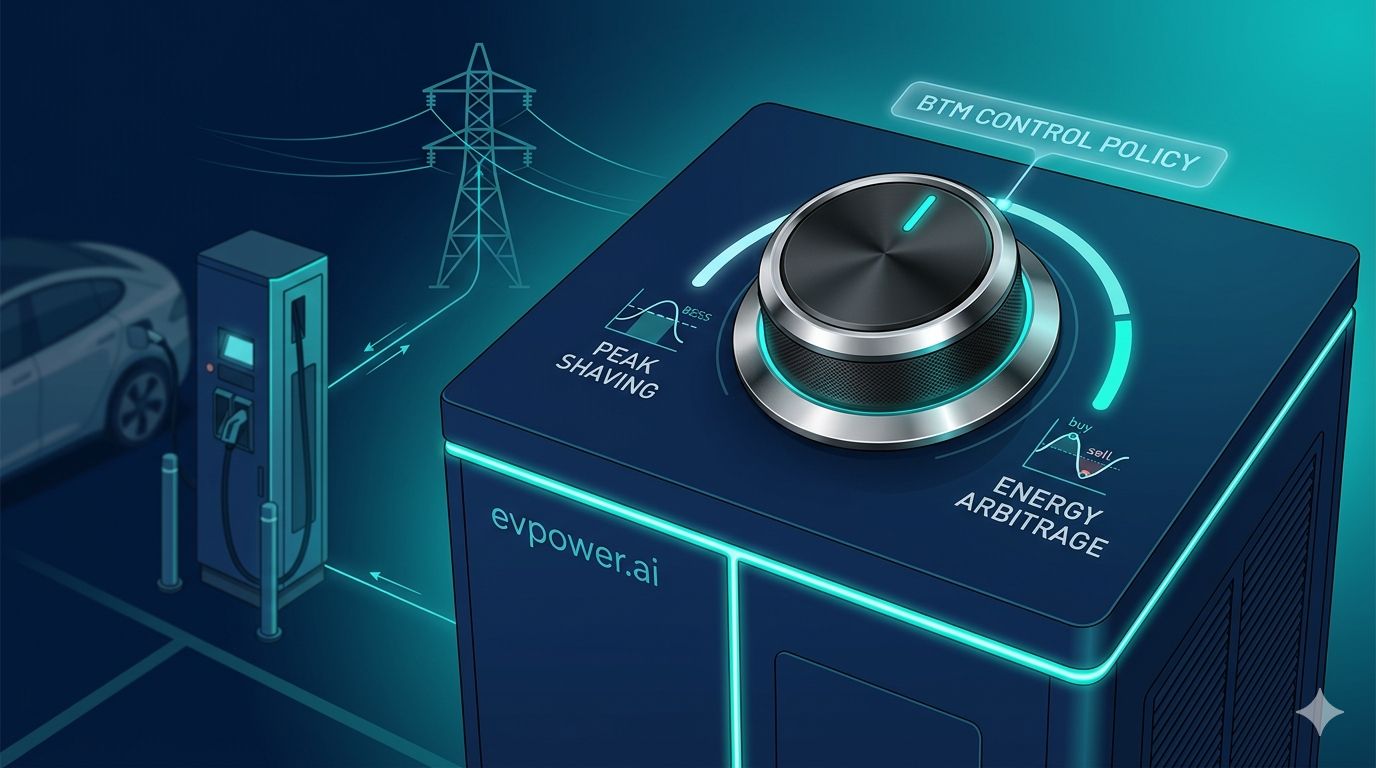
Operators who add a behind-the-meter battery (BESS) to a DC fast-charging site usually think of it as a one-trick pony, but energy storage systems are very powerful and they can do two very distinct tasks, but only one at a time.
In practice, the same battery can play two very different roles - and the control policy you choose decides which one wins. The first role is peak shaving: discharge whenever station demand spikes, so the grid connection never has to deliver the peak. The win shows up first on the cost side - smaller grid connection, lower demand charges, fewer drivers throttled when several cars plug in at once. The second role is energy arbitrage: charge when grid energy is cheap (overnight, off-peak), discharge when it's expensive. The win shows up on the margin side - every kWh sold to a driver costs the operator less than market price.
Same asset, opposite instructions. Peak shaving reacts to local demand; arbitrage reacts to time-of-day prices. So which should you pick, PeakShaver or Arbitrage?
Using evPower.ai's digital twin, we simulated a full day of synthetic EV charging sessions at a grid-constrained site (500 kW grid input, 225 kWh battery, four 180 kW dual-connector chargers, typical commercial ToU tariff) - identical transactions, identical hardware, only the control policy changed. We tracked two leading metrics: driver experience and gross profit.
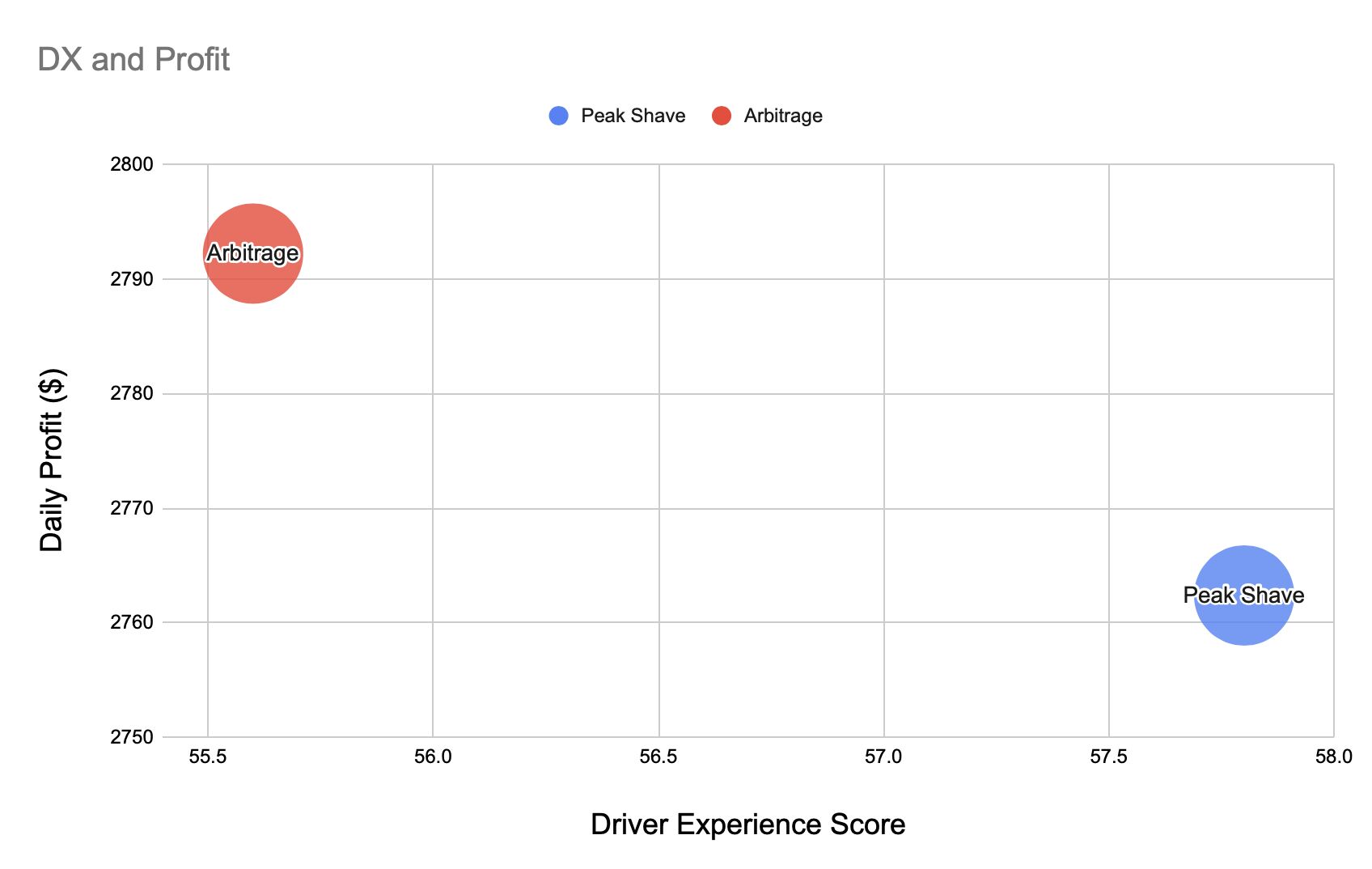
Driver experience (DX) is a compound metric capturing the quality of the charging sessions. Gross profit captures the gross margin from selling energy in $/day. PeakShaver delivered a higher DX score than Arbitrage - faster sessions, less throttling at busy moments. DX shifts are meaningful: they move drivers across the threshold of whether they come back to this station next time, and whether they tell other drivers about it. Arbitrage, on the other hand, delivered close to $1,000/month per site, enough to meaningfully change the ROI on the battery itself. This is on top of any peak-shaving gains — and scales up with site size and traffic.
There is no universally right answer. One way to success is to deploy the battery in peak-shaver mode, enhance driver experience, and over time reap the benefits of repeat customers. Another way is to use the very same hardware in arbitrage mode and increase profitability from day one. The point is that this is a real operating lever, not a configuration footnote. Picking one without modeling the site's grid headroom, demand profile, and tariff structure means leaving either money or driver satisfaction on the table - every single day the battery is on site.
Those is the kind of question our digital twin is built for: same hardware, different policies, quantified trade-offs. If you operate DC fast-charging infrastructure and want to know which policy fits your sites, load profile and tariff, feel free to reach out for a free simulation of your site.